


I have a longer post tomorrow about garden Bumble Bees, but our neighbour, Kath, told us about these beautiful fungi growing under a group of trees in a small park just down the road. Needless to say, we had to visit and were not disappointed.
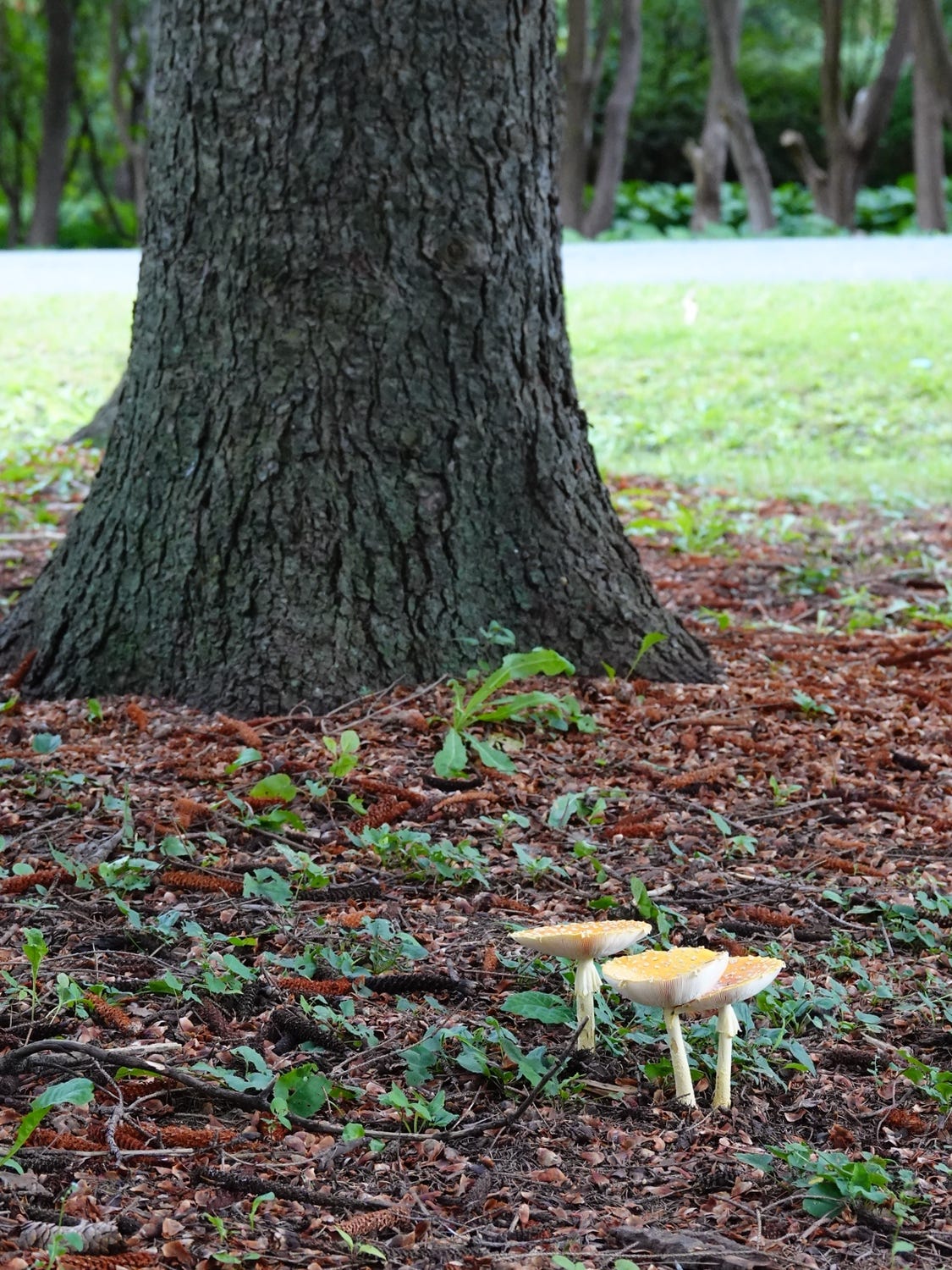
American Yellow Fly Agaric (Amanita muscaria var. guessowii) is a North American variant of the common and more frequently seen red fungi that occurs in wooded areas all over this continent as well as in Europe and parts of Asia. This variant is to be found in the northern Midwest and in eastern North America from the boreal forests of the northeast, south to the Appalachians.
(Quote): The taxonomy of the Amanita muscaria species group will very likely change in the near future. A 2006 study by Geml and collaborators found DNA support for the idea that the color of the cap and warts in Amanita muscaria is not necessarily indicative of phylogenetic differences. The study used molecular dating techniques to hypothesize that “the ancestral population of A. muscaria likely evolved in the Siberian-Beringian region and underwent fragmentation . . . The data suggest that these populations later evolved into species, expanded their range in North America and Eurasia.” As for the traditional morphological features separating “varieties,” the researchers noted that among the species determined by DNA, “all . . . share at least two morphological varieties with other species, suggesting ancestral polymorphism in pileus and wart color pre-dating their speciations.”
These fungi are toxic and psychoactive. They used to be considered to be “deadly” but in fact you would have to eat a lot of them, if only because they induce powerful nausea first. As for psychoactivity, expect dissociative effects in low to mid doses, followed by delirium and vivid hallucinations at high doses.
Beautiful things …


fascinating especially about their DNA
Very pretty fungi, and it's interesting to read about their genetics