
When All Goes Quiet, and It's Hot
20 July

Summer Botanising
As summer progresses and gets hotter, most birds have fledged their young and no longer need to keep singing and proclaiming their territories. Naturally, our thoughts start to turn elsewhere. Preferably to doing things in the cool shadows. There was a period in my younger days when I expected that I would develop a career as an entomologist, but life and the need fir a paying job got in the way and my biologising turned from six legged life those with just four. Outside the laboratory, as you will have gathered, I enjoyed birds but my wife is a botanist and in time that interest rubbed off on me. When we go out walking, while I am looking up in the trees and bushes for movement she is likely as not crouching down looking at plants. My plant interests started with my duties as the family photographer, but then I got sucked in and discovered botany can be a pretty fascinating field too. When I was very young and discovering nature I wanted to know everything about everything. Then I went down that rabbit hole and labored in a very obscure but interesting - field for decades before retiring and emerging into the light. Time once again, to know everything about everything. This time there is nobody to stop me.
Summer is the season to find and enjoy the many species of plants, especially the wildflowers. For the three summer months of June, July, and August we have found some around 150 different species within our small suburban town before we even start to think about wandering off to pastures new. A good few of those were found in our garden, though that may be because we actively encourage them to set up home here. That being said, simply strolling along the roads and through the parks looking at what is around us turns up many more. As it will for you too.
“This is a world where things move at their own pace, including a tiny lift that Fortey and I shared with a scholarly looking elderly man with whom Fortey chatted genially and familiarly as we proceeded upwards at about the rate that sediments are laid down. When the man departed, Fortey said to me: "That was a very nice chap named Norman who's spent forty-two years studying one species of plant, St. John's Wort. He retired in 1989, but he still comes in every week."
”How do you spend forty-two years on one species of plant?" I asked.
”It's remarkable, isn't it?" Fortey agreed. He thought for a moment. "He's very thorough apparently."
― Bill Bryson, A Short History of Nearly Everything
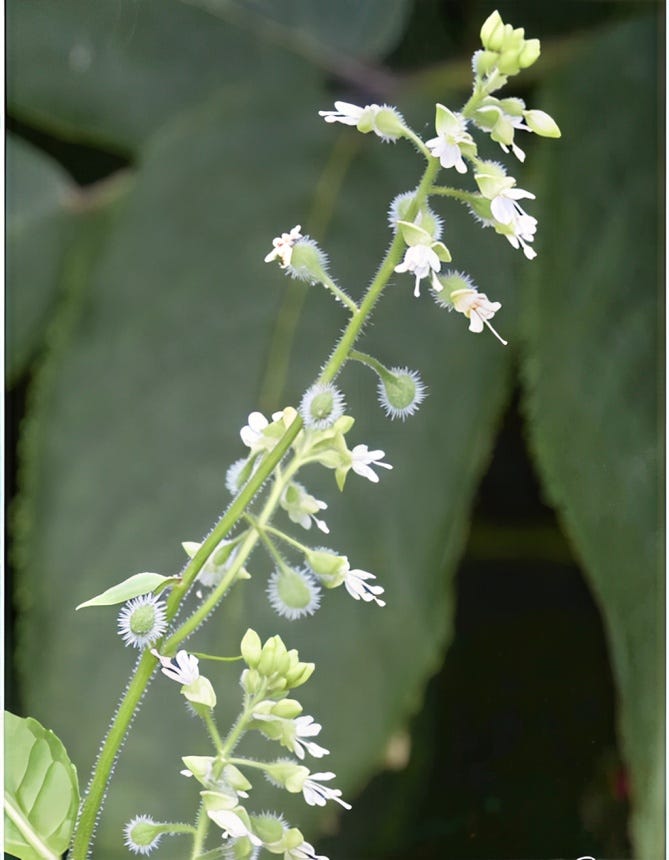
Our town would have an even richer variety of wild plants if the parks were not mown so enthusiastically, but look in the margins and there are riches to be enjoyed. Discrete flowers like Broadleaf Enchanter’s Nightshade, for example, American Bugleweed, Devil’s Beggarticks and Wormseed Sandmat. There are the show flowers like Rudbeckia and Echinacea (Orange Coneflower and Black-eyed Susan) to be seen in many gardens later in summer, the several species of Golden Rod and many diverse species of Asters and, others besides.
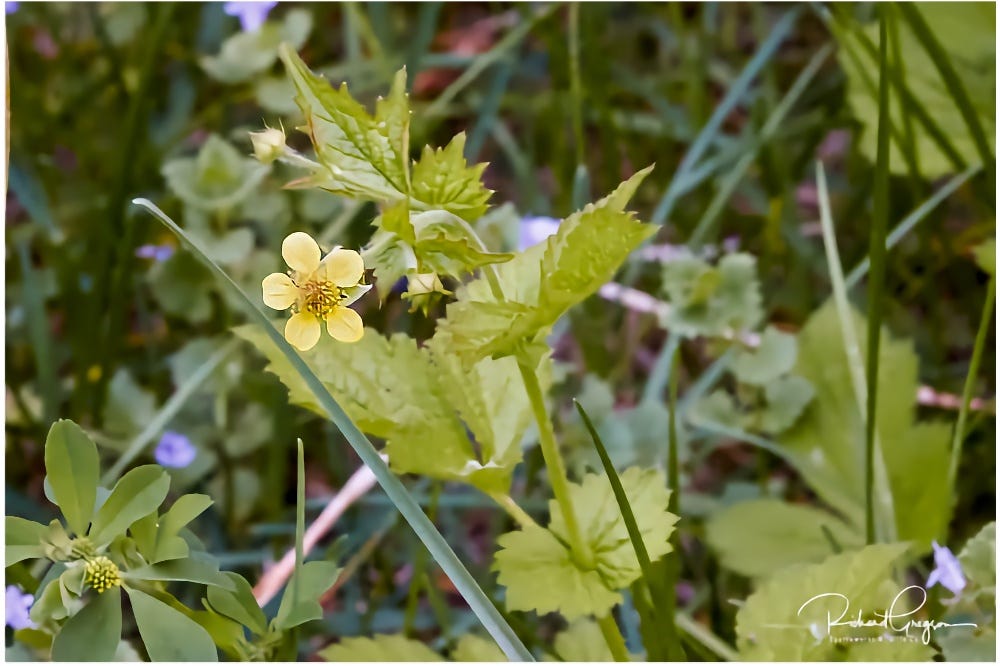
Although many of the wild plants we find are native, there is a surprisingly high proportion that are introduced species. They are generally not garden escapes, although a few are, but live here as a consequence of Montreal having been a major seaport for 400 years or more and open to the arrival of ships from Europe and other parts of the world. Inevitably, with the variety of cargoes from all over the globe, the seeds of many species have hitched a ride and a good few have liked what they found here and become fully naturalized. Common Valerian, Wild Carrot (Queen Anne’s Lace), Bird’s Foot Trefoil, Tansy, Bladder Campion, White Clover are all familiar plants from afar, and not forgetting, of course, the (in)famous Dandelion.
Most of these plants support insects which take nectar and some collect pollen. Later in the year, many will stand tall with seed-filled heads, which the birds can use to fatten for the cold weather ahead or to fuel themselves for the migration journey they cannot avoid taking. Those seed heads can provide food right through to spring, if left to stand.
Plants have one supreme advantage over all the other lifeforms. On the whole they don’t move around, they stay still when you want to take a photograph and study them closely and you do not have to get up before dawn to see them at their best as you would have to if birds are your passion. You can go back another day when the light is better for photography and be confident they will still be there.
“There are four different types of vegetation. First, the remnants of what we might consider as “pristine” nature—ancient woodland and other undisturbed sites. These sites are very valuable, being highly diverse and densely structured. Next, cultural landscapes—that is, where nature has been shaped and sculpted by farmers and foresters. Third, the trees and plants that have been added for ornamental reasons, an aesthetic element of urban planning. Then, finally, what Kowarik memorably classifies as “nature of the fourth kind”: the spontaneous ecosystems that have grown up on wasteland, unsupported. His point is that these new feral ecosystems, in their authenticity and self-direction, are a new form of wilderness worth preserving in their own right." (from "Islands of Abandonment: Nature Rebounding in the Post-Human Landscape" by Cal Flyn)
Generally speaking, the richest locations for wild plants are where they can grow more or less undisturbed by human activity. In my personal study area those would be undoubtedly the Arboretum and the smaller Cap-St-Jacques and Anse-à-l’Orme nature parks, all on the west of Montreal Island. These are sites where there is little grass mowing or clearing of undergrowth. They have well established trails and you can wander along at your leisure peering into odd corners. You can check out the edges of rivers and streams where a, sometimes narrow, band of undisturbed vegetation will usually develop. Keep your eyes open around woodland edges and hedgerows - all worth attention.
And, of course, don’t forget your own garden. Hopefully you will already be welcoming native plants to corners of your garden even if you are not yet quite ready to go the whole no-mow hog and turn over your lawn to wild flowers. Whichever stage your gardening has reached, there are more than likely corners that you rarely touch where errant seeds and wandering runners may have set up home if you look. Remember that not everything is a “weed” and also that so-called weeds are often the most interesting plants.
Go for a slow walk … and if you want an assistant to help you identify the plants that you will undoubtedly encounter let me suggest downloading the iNaturalist app to your phone. Look down. Pay attention. Let curiosity lead the way. Wildflower-watching is more than a hobby—it’s a way to reconnect with the rhythms of the land and notice the small, beautiful things that make life richer. Then it will be autumn, migration will start again and time to look up once again as birds leave for the south.
Picture of the Week
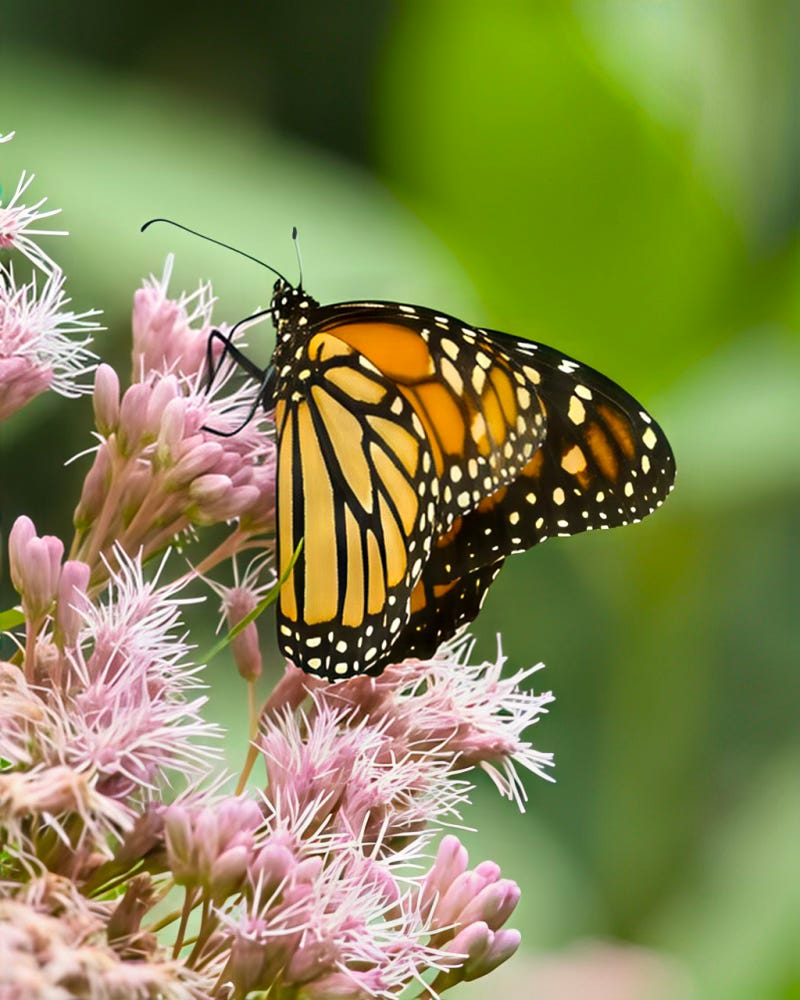
I am sometimes asked “Where have all the Monarchs gone? I planted milkweed in my garden and haven’t seen any?” Much of the answer is that, like everything in nature, there is a season for Monarchs and it is usually not until around now that they become evident around here, coinciding with the milkweed flowering season and the presence of mature enough plants for them to lay eggs on. They are now with us.

Becoming Birders
I found this in a delightful substack (link below) that includes photographs of more Puffins than you can shake a stick at …
One of life’s truisms is that every day we all inch closer to becoming birders. One day, around your 30s, you’re appreciating a good chirp and next thing you know, you’re downloading the Merlin Bird ID app. I don’t know, maybe it’s their ability to fly, or escape, that becomes more appealing as we enter years of burden and responsibility. Whatever it is, there’s some biological urge that slowly nudges us towards admiring the creatures of the sky.
This is taken from:

Getting people outside - access to greenery and gardens
Access to nature is a public service, and nobody should be left behind
(Quote): A few years ago, I won a grant to pilot an ecology programme for kids. We ran sessions at a rural school and in central Cambridge, and it was all free. We paid for their transport, their food and all the kit. We set up an online space so that students could ask questions and get to know each other between sessions. Crucially, we invited them into spaces that, from the outside, likely looked intimidating and ‘not for them’—places emblazoned with the University of Cambridge crest and shut away behind big, scary doors. We let them run around the immaculate grounds of a University of Cambridge college with ecology field kit, working on their own science projects. We invited them to an exclusive event at the University’s Museum of Zoology. While the Museum was closed to the public, we opened it just for them. We printed off huge posters so they could showcase their science projects, which they got to see displayed in the beautiful glass entrance hall of the Museum, above which hangs a huge fin whale skeleton. The whole point was to make them feel valued.
It worked.

Ending with a bit of fun … the link below is to a video of a Loon landing on the still water of a lake. I had to smile when I saw it.
Excellent read! I'm so grateful to have found this platform. Just arrived yesterday and I'm already finding so much rich reading material like yours here. It indeed has been lonely around my garden this month compared to to the previous several weeks when it was baby bird overload around here, but that is the great circle! I did, however, spot my first monarch yesterday on my hibiscus 🌺 😃
P.s. have you ever listened to ‘The Science of Birds’ podcast? It has so much great info in a fun to listen to way
Such a lovely and generous post with your wonderful pics! and info and many links! Happy as I can be to have just downloaded "Islands of Abandonment: Nature Rebounding in the Post-Human Landscape" by Cal Flyn from Libby at my library. Also liked the snippet from Bill Bryson, a favorite of mine for his view of this world.
I happen to have another Geum in my yard. It is Mrs. Bradshaw's Geum which is a happy red and has been offered by one of our local and noted seedsman, Ed Hume for many years. I like it because it blooms early and last at least a month and then may bloom again when things cool down. Though it does die back in winter, it takes cold with some mulching. Though I don't know about your cold winters! One can only give it a try and see how it does.