At the end of January? 🥶
It’s never too cold to notice what’s around us.
On “Noticing”
It took two months or more to reach me, here in Canada, because of the pre-Christmas Canada Post strike and the massive backlog of parcels that caused, but I finally received my copy of, “Homecoming” by Melissa Harrison, a guided journal to lead you back into nature. It’s a fine idea. I wanted to highlight the use she makes of the word noticing. This is exactly what I try to encourage readers to do when I assemble my newsletters each weekend, and is the perfect word for our interactions with the natural world. Why did I not use it? I hope she won’t mind my borrowing it.
Meanwhile, here is a link for you to find her book …
Winter Bird of the Week
I’ll be honest—this picture of a Common Redpoll comes from an earlier year … as thus far they have not put in an appearance on my walking routes. Perhaps they are visiting you this winter? Fingers crossed we get a few dropping by when they start heading north again.
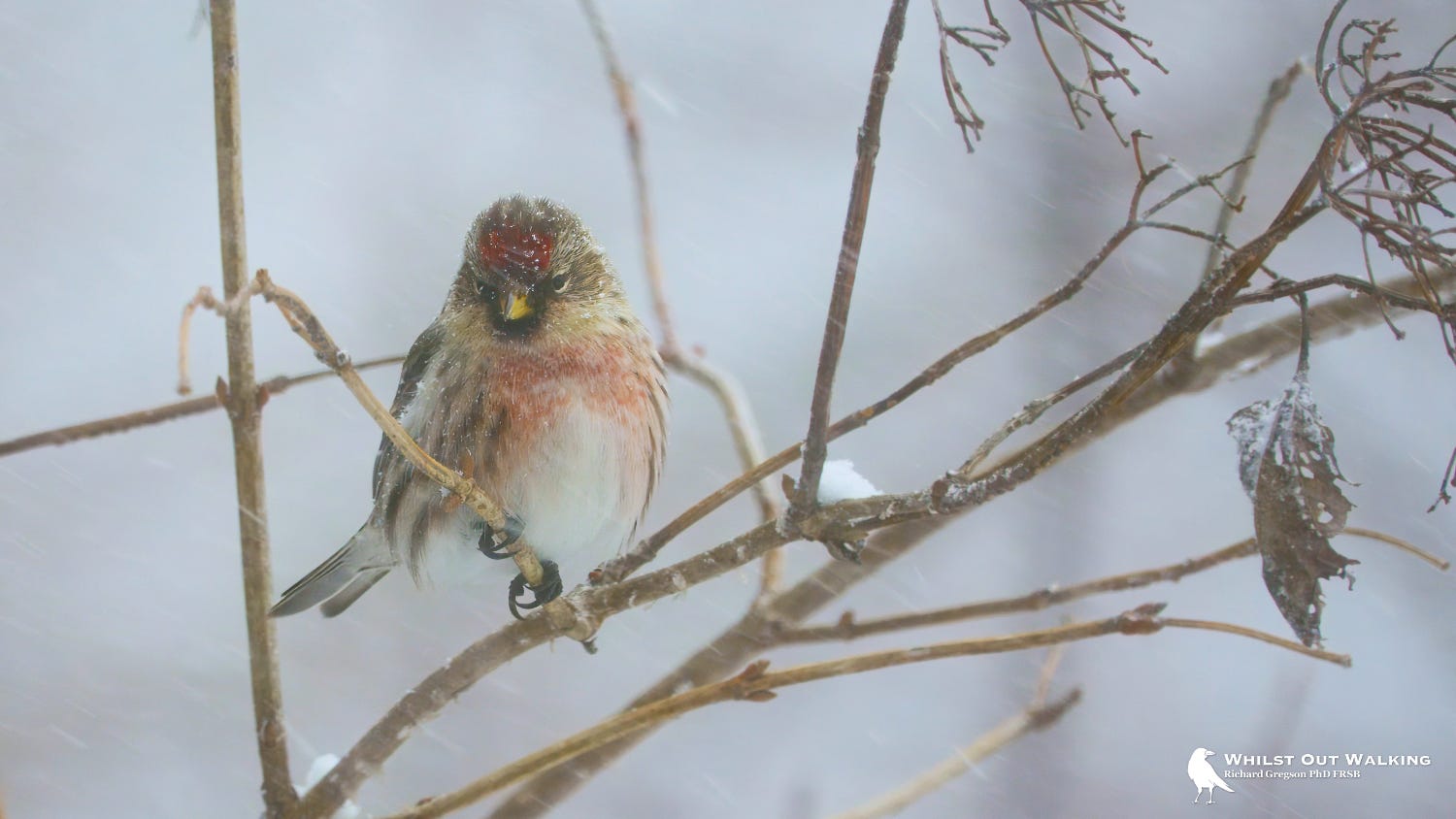
Redpolls—hardy Arctic finches—come south some years in search of food, mostly driven by fluctuations in the availability of northern boreal seed crops. These irruptive migrations are generally unpredictable, but when they happen small flocks of birds come to my feeders. Pine Siskins too - just not yet this winter. Redpolls are well-adapted to tough conditions, having specialized throat pouches for temporarily storing seeds and a particularly dense plumage that insulates them against sub-zero temperatures. Recent genetic studies have resulted in the "lumping" of Redpolls, that were once divided into three separate species—Common, Hoary, and Lesser—into one single species, Acanthis flammea. While clearly distinguishable plumage differences exist, it is now accepted that extensive interbreeding and minimal genetic divergence, mean that the various “forms” previously considered to be separate, if related species are, for all that, just part of one species. Adaptive traits, moderated by environmental factors, can create remarkable variation within a species without true reproductive isolation - look at our own species, for example.
… and Mammal of the Week
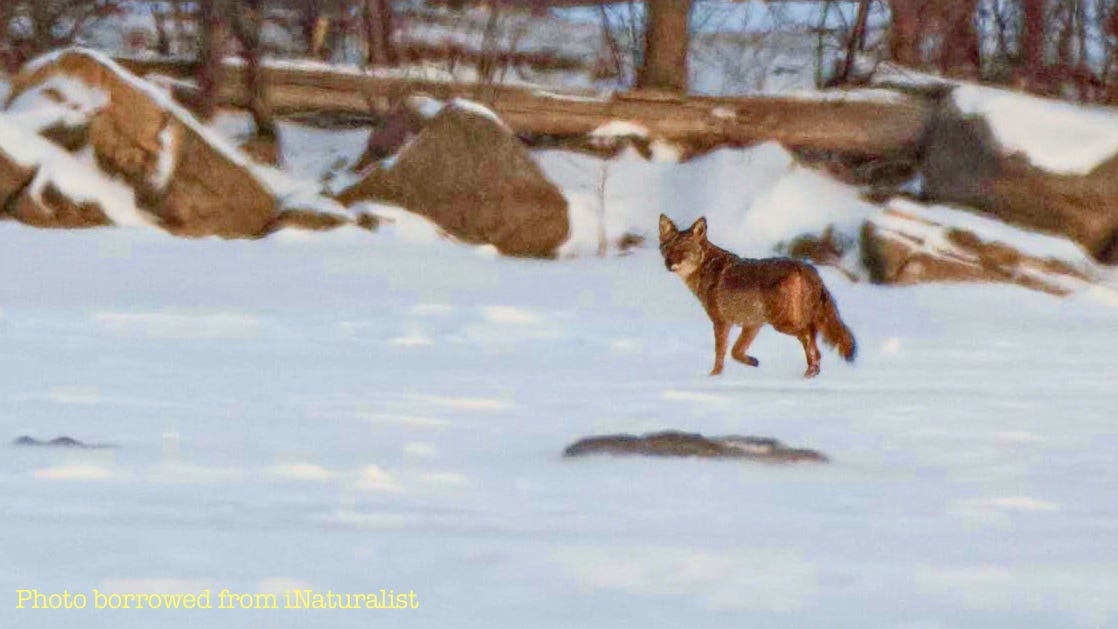
Despite there being a small population of Coyotes in and near to the Arboretum north of the Trans-Canada Highway, they only occasionally make themselves known in the residential area. This year reports in the town are indicating that at least three separate animals and perhaps more have moved in, aided by easy access across the ice of the frozen river. Of course, this means we have been having the annual social media posts along the lines of “will they eat my cat, dog, child” to which the answer is a clear no, but that this is yet one more good reason to keep your cats indoors.
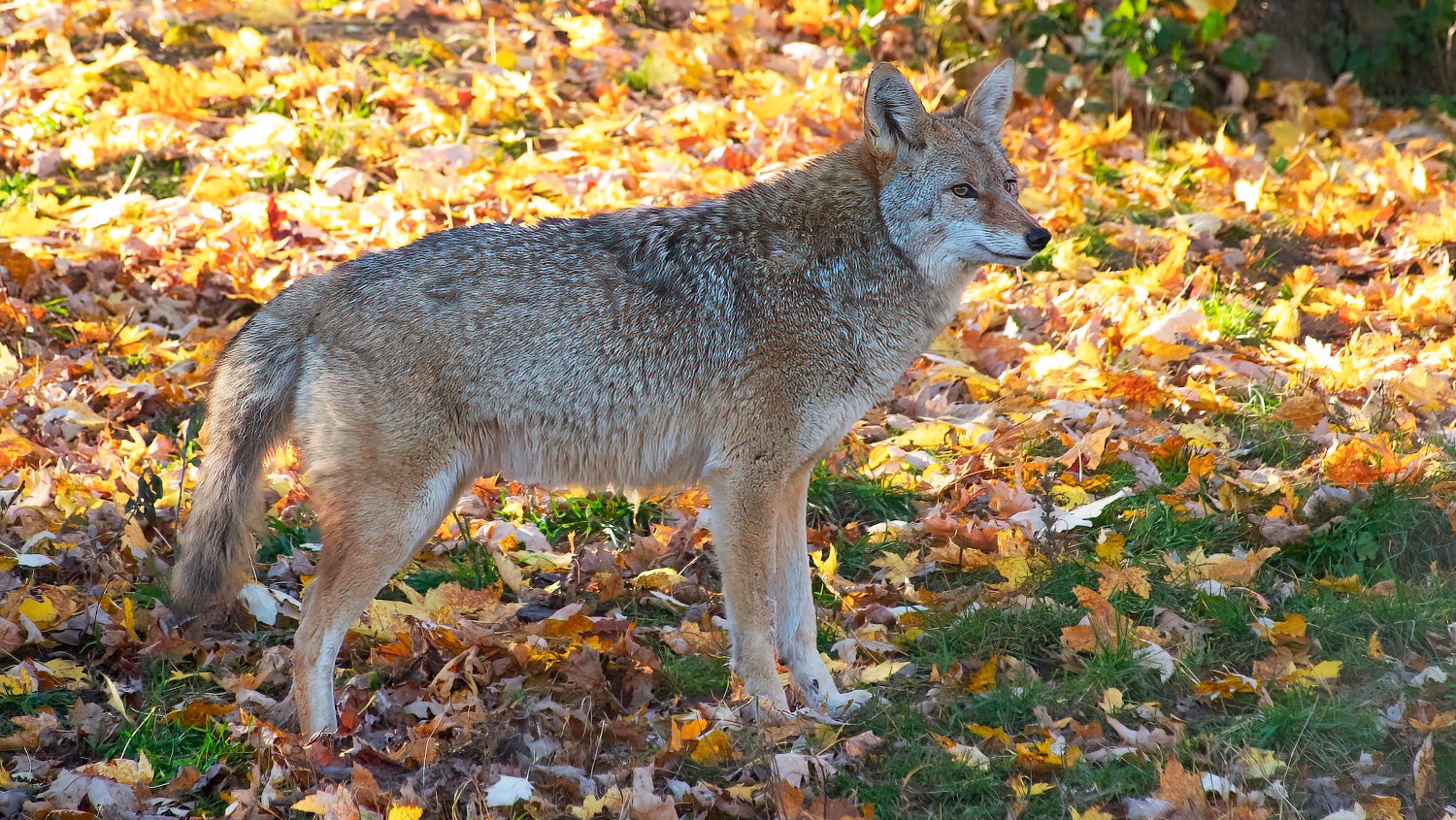
Coyotes are generalists and an extremely successful species, so trying to keep them away from the places we live in is just wasted effort. Especially as we have so many squirrels for them to feed on. To reach our town they can, and do, cross the two highways but also will cross the river ice - on which they have been seen recently. I have to say that I am much more concerned personally about meeting wandering and uncontrolled domestic dogs than I ever am about Coyotes.
Just Getting through winter
There are few climatic zones on earth that some species of birds have not managed to make a home in. It is always interesting to enjoy the birds near us, even with winters that spend at least a few days below -20C, colder with wind-chill, manage to make a living without migrating. How do they do it? What strategies make survivable possible? No one solution is universally applicable, but winter residents adopt at least a couple of the following means of getting through until spring.
Flocking—gathering in groups
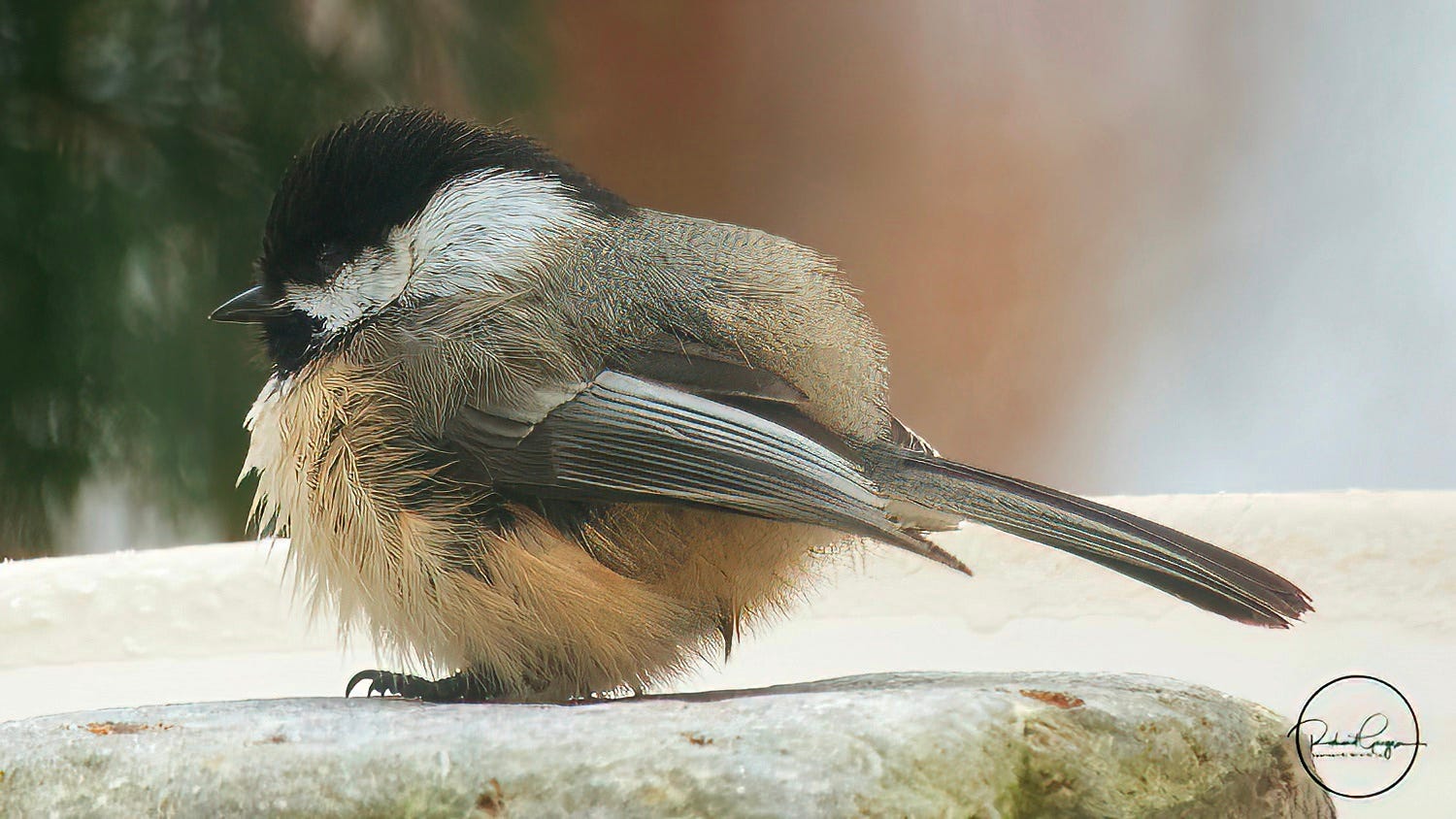
Winter birding can leave you wondering where the birds have got to. During warm weather, birds stick to their territories, but in winter, they often benefit from grouping together in a loose, mixed feeding flock. Groups of Chickadees, for example, frequently have one or two individuals of other species flying along with them. This improves the chances of locating food and provides safety in numbers. When it is freezing and food is scarce, individual birds need to spend almost all of their time searching for food to keep their energy levels up. Then, at night, it is beneficial sometimes to roost alongside other birds, which helps conserve body heat, and, again, to minimise the risk of predation.
Don’t stop eating
Finding food in the depths of winter can be difficult. It is hard, sometimes, to find enough to build and maintain adequate fat supplies to store on the body and ‘burn’ for energy. The smallest birds really have to be constantly feeding throughout the hours of daylight in winter. Some species will eat as much as 30% of their body weight every day to make it through the long, cold nights. Some birds prepare for the colder months by squirreling away supplies. Blue Jays, for example, Nuthatches, Chickadees, and others all cache supplies as winter approaches — sometimes they even remember where too! It is often not the cold that kills birds but lack of food. American Robins, for example, are a species that “everyone” knows will leave in winter when, in fact, there are always a few hardy individuals to be found hereabouts. If the ground becomes too hard or buried under ice and snow for ground feeding birds to probe for food, there may still be berries on bushes and seeds on flower stalks that have not been mown by over-eager gardeners. Don’t tidy your garden in the fall but leave seed heads to stand, and you will certainly see many birds outside your windows.
Feathers
Thinking of birds on a cold winter’s day and many of us imagine a plump little ball with two stick legs! Many birds will fluff up their feathers when it’s cold and so increase the amount of air held against their bodies to prevent heat loss. Birds also grow more downy feathers in the colder months, and these soft feathers found closest to the skin also help keep birds warm in winter. We don’t put down in our own winter jackets for nothing — it is superb at conserving heat.
Make the most of garden feeders
The colder it gets, the more birds will visit your garden looking for shelter and a meal. It is important that we provide food regularly. You will see quite a flurry of bird activity first thing in the morning as they replenish energy lost overnight, and again they will visit last thing in the afternoon to prepare for the long night ahead. I have written before about the increasing local population of Carolina Wrens that we welcome in winter — in great part this is because gardens feeders are so indispensable in supplementing the limited natural foods available to ground feeding species that cannot burrow through the snow to find a meal.
If all else fails, fight for your snacks
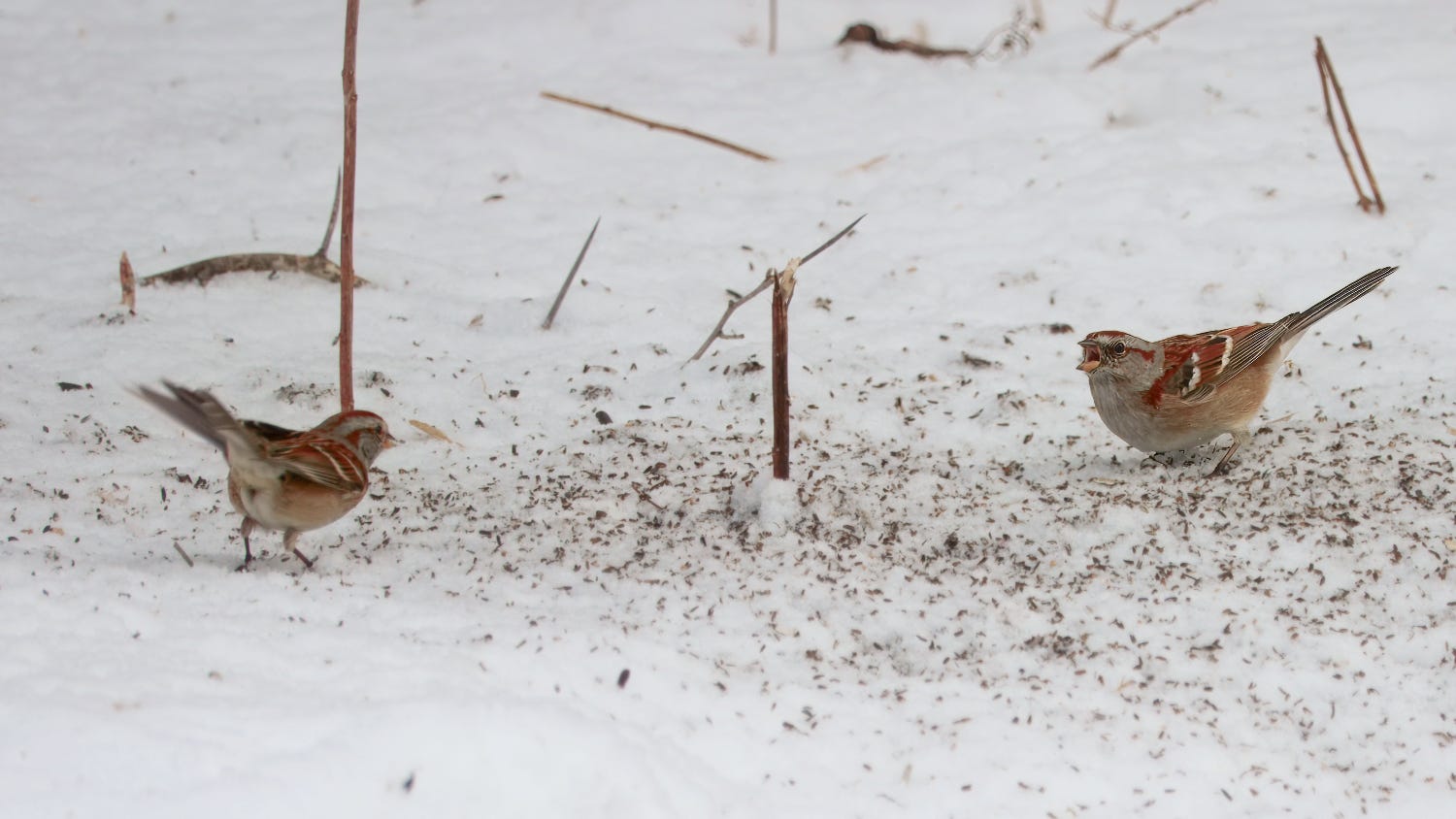
BUT … Why not just migrate?
That’s easy - birds that can stay and survive through the winter get the first chance of finding optimum breeding habitat before the long-distance migrators return from the south. It’s a trade-off that benefits the species - a few months of hardship in exchange for optimum breeding opportunities. Worth taking the risk.
I was “Out Walking” around here this week
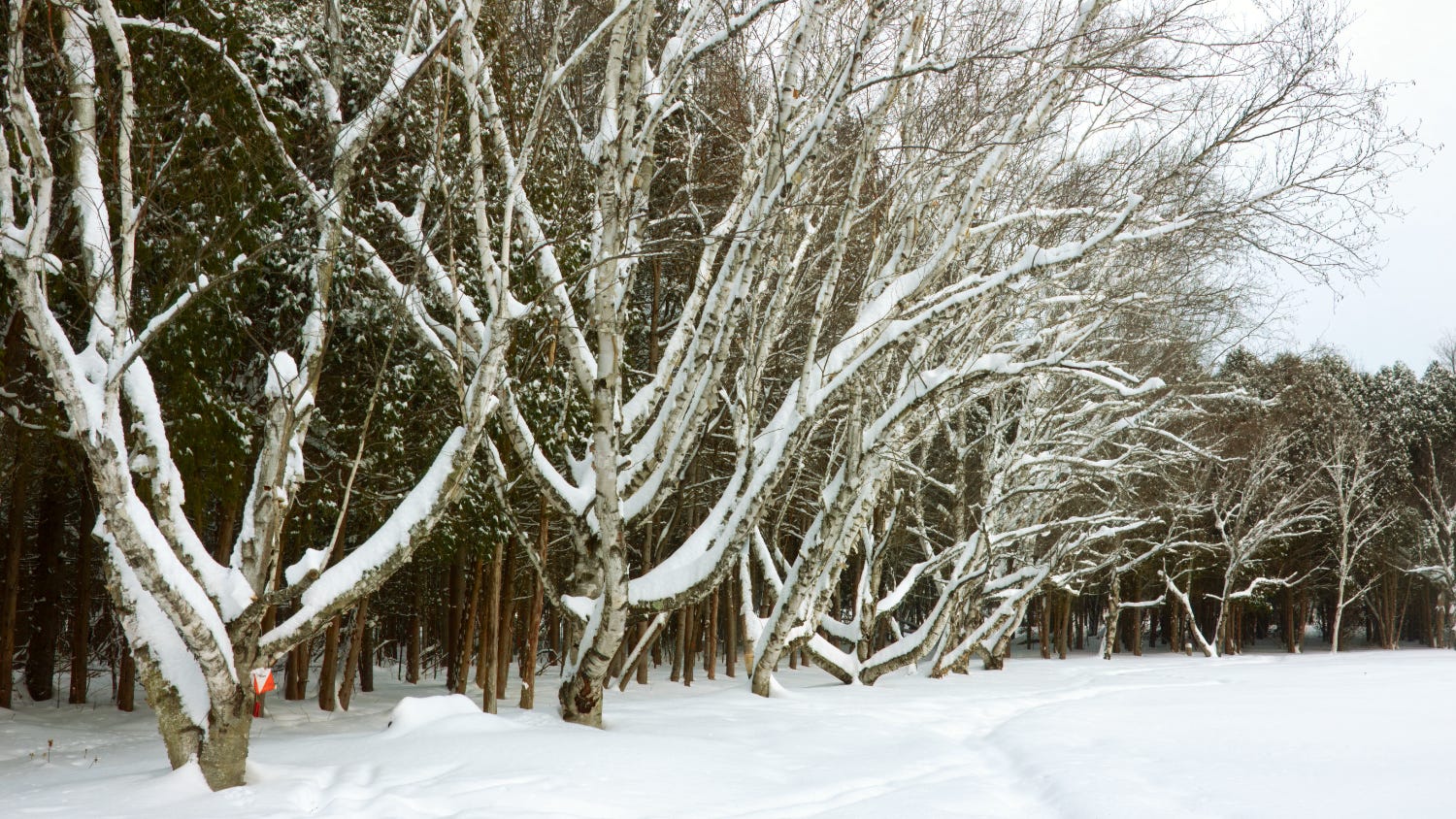
Brrr! This week has been the chilliest of winter so far - the locals would say Il fait ben frette. Overnight and morning temperatures dropped below -20 degrees Celsius every day, and with the windchill, it felt a good bit colder. Down to -29C last Monday night. Even the daytime highs never got above -10 degrees Celsius. To stay warm, we bundled up in thick coats, heavy boots, and striped on our snowshoes. Never forgetting the trusty rechargeable hand warmers inside our gloves. Taking a photo on such days is a must, but it’s a bit of a challenge - you have to take off your glove first! As for entering bird sightings on eBird via my iPhone, I try to save them in memory and only enter them in batches every twenty minutes or so. For all that, we enjoy the challenge of winter walking. 🥶

How could I possibly overlook an article titled “Starlings are the best birds and I will die on this hill “?
Not my absolute best, that’s the House Sparrow, closely followed by assorted Wrens, but the European Starling is way up near to the top of my list. I know, I know, alien invaders and all that, but it doesn’t stop them being pretty impressive animals … and that Starling plumage is gorgeous when you look at it in detail.


Far too early to be out there getting our hands dirty - and anyway the wild is frozen solid under a lot of snow and will remain so until sometime in March … BUT, the seed catalogues have begun to arrive.
Time to be planning 👨🌾

Very delightful post Richard! Here in PDX Oregon we've seen nary a smidgeon of snow so the little fluffed birds are merrily hopping around our leaf strewn yard looking for treats. If and when it snows we'll haul out our bags of seeds and millet!
Interesting about the Coyotes and that image from Autumn looks like that Coyote has a good thick coat all ready for the Winter. On my hike today, I came across tracks of Coyotes, likely a pair, that had been through the conservation area where I regularly hike in the Western part of Ottawa. They aren't resident to the conservation area but do seem to pass through a few times a month. I imagine they annoy the local familes of Red Foxes though.